%20--%3e%3cdefs%3e%3cstyle%3e%20.st0%20{%20fill:%20none;%20stroke:%20%230f172a;%20stroke-linecap:%20round;%20stroke-width:%205.5px;%20}%20.st1%20{%20fill:%20%2310b981;%20}%20%3c/style%3e%3c/defs%3e%3cpath%20class='st0'%20d='M2.75,42.01v-20.12C2.75,11.32,11.32,2.75,21.89,2.75s19.14,8.57,19.14,19.14v20.12'/%3e%3cpath%20class='st0'%20d='M14.12,42.01v-13.62c0-4.29,3.48-7.78,7.78-7.78s7.78,3.48,7.78,7.78v13.62'/%3e%3ccircle%20class='st1'%20cx='21.89'%20cy='11.74'%20r='4.98'/%3e%3c/svg%3e)
8 Steps to Turn Contractor Onboarding Into a Gate for Site Managers
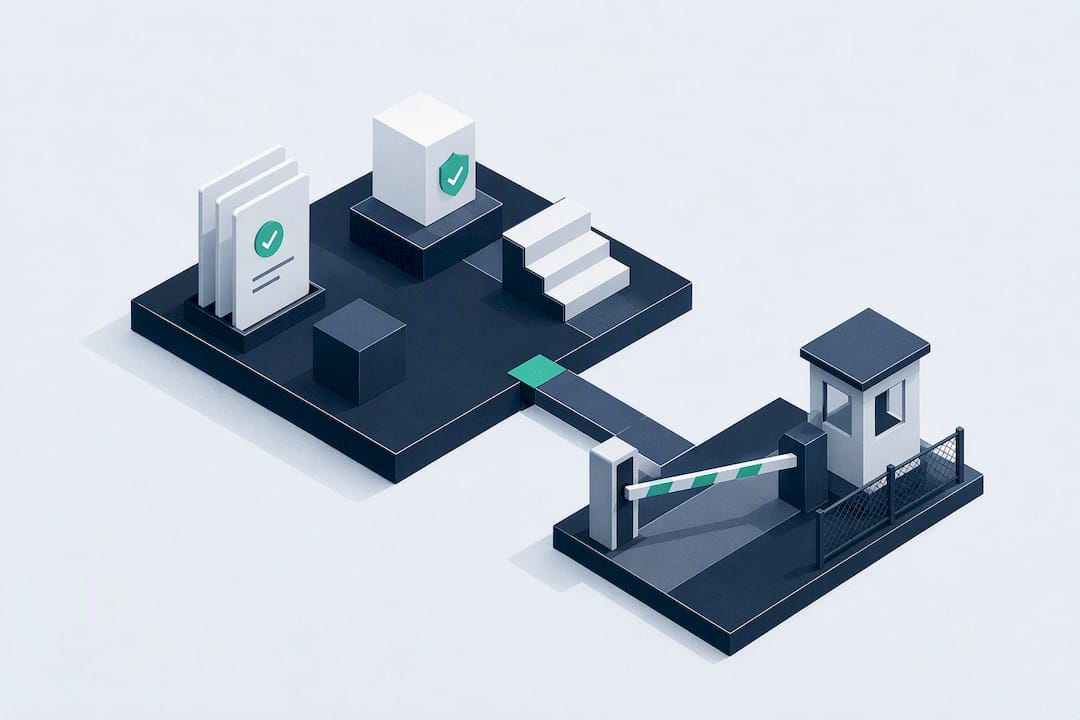
A contractor onboarding process has one job: confirm a contractor is who they say they are, is qualified for the work, and understands the specific hazards on your site before you let them past the gate. That means running two phases: pre-arrival verification, then on-site induction, with access tied directly to induction completion. A platform like EntryWatch can enforce that gate and keep a timestamped record of every step, which is what an audit or an incident investigation will ask for first.
TL;DR:
- Separating pre-arrival verification from on-site induction ensures faster access and clearer records, with each phase checking different contractor qualifications.
- Pre-arrival checks should include government-issued IDs, current insurance, valid licenses, and specific task RAMS, while on-site content covers site layout, hazards, and emergency procedures.
- Linking induction status directly to site access through digital badges, QR codes, or kiosks prevents contractors from entering zones they were not cleared for and enables real-time visibility.
- Records of induction must include content version, completion time, assessment scores, and sign-in/out data to support audits and incident investigations confidently.
- Piloting a new onboarding workflow with one trade group for 30 days helps identify weaknesses in time-to-induction and record retrieval, streamlining site-wide implementation.
Table of Contents
- What Are the Two Phases of a Contractor Onboarding Process?
- What Belongs on a Contractor Onboarding Checklist?
- How Do You Link Induction Status to Site Access?
- What Evidence Proves a Contractor Was Properly Inducted?
- Who Owns Each Step, and When Does Re-Induction Kick In?
- How Do You Roll Out a Contractor Onboarding Workflow in 8 Steps?
- Why Induction Has to Be a Control, Not a Checkbox
- How EntryWatch Puts This Workflow Into Practice
- Sources
- FAQ
What Are the Two Phases of a Contractor Onboarding Process?
Separating pre-arrival verification from on-site induction is the single biggest improvement most sites can make. Trying to check insurance certificates, license expiry, and RAMS or SWMS documents at the gate while a contractor waits creates the exact bottleneck that pressures supervisors into waving people through.
Phase 1, pre-arrival, happens before anyone shows up. It covers document collection and eligibility checks: insurance coverage, trade licenses, competence records, and method statements (RAMS/SWMS) reviewed and approved.
Phase 2, on-site induction, happens the moment they arrive. This is where site-specific knowledge gets delivered: current layout, live hazards, emergency procedures, and any permit-to-work rules in effect that day.
The split matters because the two phases test different things:
- Pre-arrival answers “are they allowed to work here at all?”
- On-site induction answers “do they understand today’s specific risks?”
- Keeping them separate means arrival day is fast, and the record shows exactly what was checked and when.
Site inductions must be site-specific under UK health and safety guidance, covering particular risks, emergency arrangements, and control measures, not a generic slideshow. Industry best-practice guides reinforce the same split: verify competencies and paperwork before the visit, deliver induction content on arrival, and link induction status to physical access.
What Belongs on a Contractor Onboarding Checklist?
A contractor induction checklist works best when it is built in two matching halves: what you collect before arrival, and what you verify once they are standing at the gate.
Pre-arrival document checklist:
- Government-issued ID and company details
- Current insurance certificates (public liability, workers’ comp as applicable)
- Trade licenses and qualification records, with expiry dates flagged
- RAMS or SWMS for the specific task
- Emergency contact details for the individual and their employer
On-site induction content modules:
- Site layout, entry and exit routes, restricted zones
- PPE requirements for the zones they will enter
- Muster points and evacuation procedures
- Incident and near-miss reporting process
- Permit-to-work rules for hot work, confined space, or working at height
The evidence trail matters as much as the content. Every completed induction should log which version of the content was delivered, the exact timestamp, who delivered it, the result of any comprehension check, and the sign-in and sign-out times tied to that specific visit.
Pro Tip: Keep induction content in modules rather than one long document. A one-day electrician needs the general site module plus one hazard-specific add-on, not the same 40-minute induction you’d give a six-month renovation crew.
How Do You Link Induction Status to Site Access?

The most common failure in contractor programs isn’t a missing document. It’s a disconnected system: induction records live in a spreadsheet or a filing cabinet, while site access is controlled at a gate or reception desk that has no way of checking that record in real time. A contractor can be “inducted” on paper and still walk into a zone they were never cleared for, because nothing at the point of entry actually checks.
Closing that gap requires making induction status a precondition for access, not a parallel paperwork trail. Workable patterns include:
- Requiring pre-arrival modules to be completed online before a QR code or badge is issued
- Using self-service kiosks so contractors check in, confirm induction status, and get access instantly without a receptionist as a bottleneck
- Printing time-limited badges or QR passes tied to the specific induction record
- Linking the sign-in system directly to evacuation and roll-call tools so anyone on site shows up automatically in an emergency headcount
Pairing sign-in with induction status means no contractor can start work without a current induction, and it gives supervisors a live “on site now” view instead of a guess.
| Control gap | Fix |
|---|---|
| Induction record separate from gate access | Gate sign-in on induction completion status |
| No visibility into who’s on site right now | Live dashboard tied to sign-in/out timestamps |
| Escorted visitors treated like inducted contractors | Role-based zone permissions by induction type |
| Supervisor overrides go unrecorded | Log every override with name, reason, timestamp |
Sites with unreliable connectivity still need an offline fallback, such as a printed QR pass a supervisor can scan later, so a signal drop never becomes a reason to skip the check entirely. Role-based zone permissions prevent the specific blind spot where someone with a valid induction for one area wanders into a zone they were never cleared for.
What Evidence Proves a Contractor Was Properly Inducted?
A signature on an induction form proves someone was present. It doesn’t prove they understood anything, and that distinction is exactly what an investigator or insurer will probe after an incident. The stronger approach pairs the induction with a short comprehension check, five to ten questions or a brief demonstration for genuinely high-risk tasks like confined space entry or working at height.
A defensible record links several pieces together automatically:
- The exact version of the induction content delivered
- Completion timestamp and who delivered it
- Assessment score or demonstration sign-off
- Access permissions granted as a result
- The sign-in and sign-out entries for that visit
When these pieces sit in one auditable trail, answering a regulator’s question or an insurer’s query after an incident becomes a lookup, not a scramble through email threads and paper files. A short comprehension check also does something a signature never can: it flags the contractor who clearly wasn’t listening before they’re standing in a live hazard zone.
Who Owns Each Step, and When Does Re-Induction Kick In?
Ownership splits cleanly along the same line as the two-phase workflow. Procurement or vendor management owns pre-arrival checks, chasing insurance renewals and verifying licenses before a contractor is approved to visit. Site operations and safety supervisors own on-site induction, delivering site-specific content and confirming understanding before granting access.
Re-induction isn’t a one-time event. Common triggers include:
- Induction or license expiry
- A new task, zone, or piece of equipment the contractor hasn’t worked with before
- New hazards introduced since their last visit
- A new permit-to-work requirement
- An extended absence from site (commonly 30 to 90 days depending on the work)
At every shift handover, the supervisor taking over should confirm current induction status and log any day-of authorization they grant personally, rather than assuming the morning crew’s checks still apply.
How Do You Roll Out a Contractor Onboarding Workflow in 8 Steps?
Getting from a folder of paper forms to a working contractor onboarding workflow doesn’t require a full year-long project. It requires a pilot.
- Map risk zones and hazard categories across the site
- Set pre-arrival document requirements per contractor type
- Build modular induction content matched to those zones
- Choose a gating method: QR pass, kiosk sign-in, or both
- Set pass criteria for comprehension checks
- Integrate the system with access control and evacuation roll call
- Train supervisors on override procedures and audit expectations
- Pilot with one trade group, then iterate
Pro Tip: Run the pilot for 30 days with one trade group before rolling it out site-wide. Track percent inducted on arrival, time-to-access, and how fast you can retrieve a record during a mock audit, then fix the weak points before scaling.
Why Induction Has to Be a Control, Not a Checkbox
The gap between what most contractor programs promise and what they actually deliver comes down to one habit: treating induction as a document to file rather than a gate that decides who gets access. A folder full of signed forms feels like compliance. It isn’t, if nothing at the entry point actually checks against it.
The pitfalls we see repeat across industries: induction records stored separately from access control, on-site inductions so long that supervisors start skipping content under time pressure, and no live view of who is actually on site right now. Fix the link between induction and access first. Everything else, comprehension checks, versioning, re-induction rules, builds on that foundation.
— Flipmind
How EntryWatch Puts This Workflow Into Practice
EntryWatch is built around the exact gate this article describes: no completed induction, no access. Contractors complete digital induction forms and pre-arrival checks before they arrive, then confirm their identity through contactless sign-in or a self-service kiosk on site, with badge and QR printing issued once their record clears.
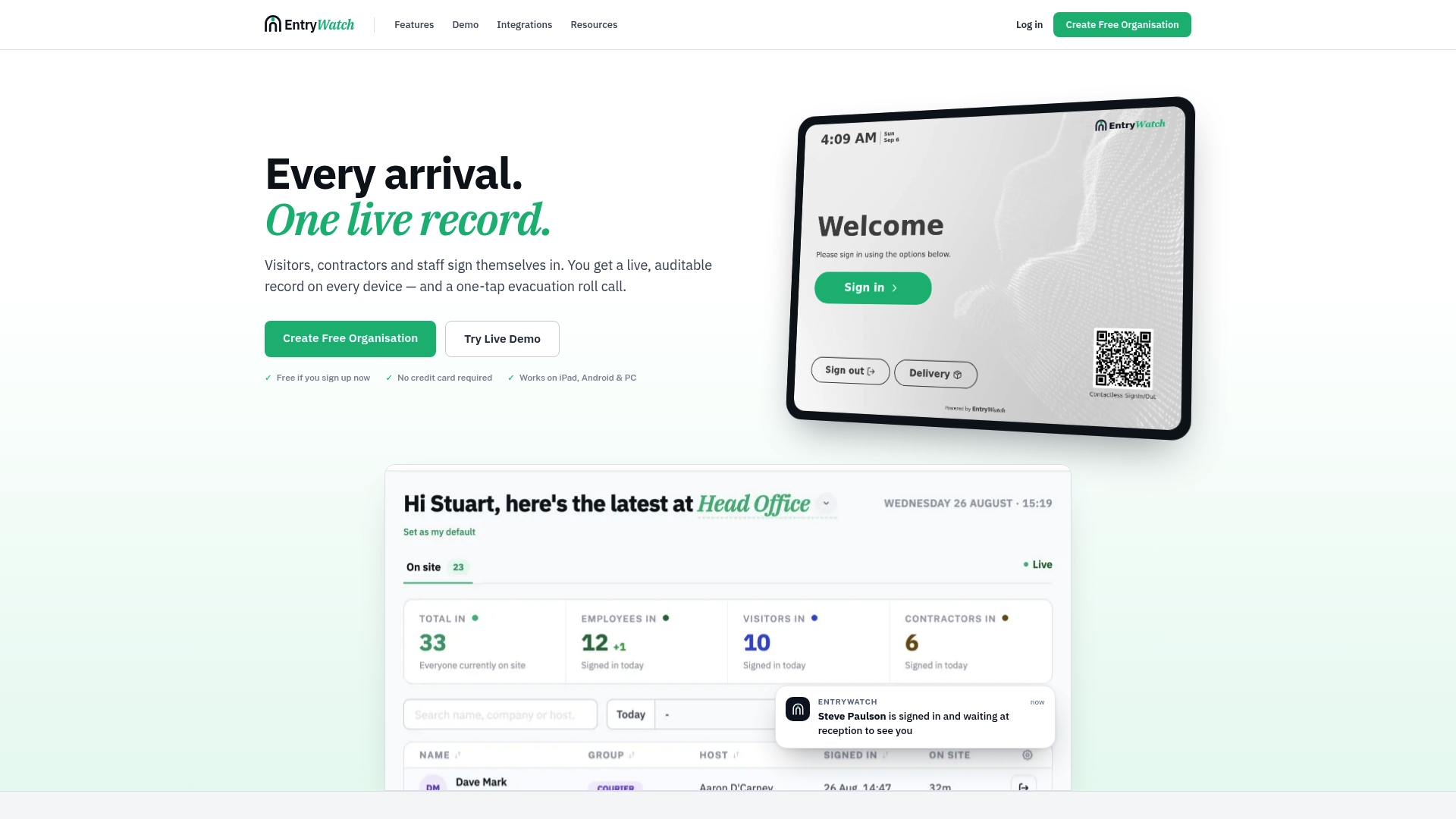
On a construction site, a subcontractor can complete pre-arrival modules from their phone the night before, then tap through a kiosk at the gate the next morning without a supervisor manually checking paperwork. In a healthcare facility, a maintenance contractor entering a restricted clinical zone gets checked against role-based access rules before their badge prints, and shows up instantly in an evacuation roll call if the fire alarm goes off ten minutes later. Every step, from sign-in to induction version to comprehension check, lands in one timestamped, auditable record instead of three disconnected systems.
If your current process relies on paper sign-in sheets and a filing cabinet of insurance certificates, a pilot is the fastest way to see the difference. Explore the visitor management system or look at kiosk sign-in options for your next site rollout.
Sources
- HSE: Site rules and induction
- Contractor Safety Induction: Checklist & Best Practices
- ComtyLink: Contractor sign-in vs inductions
- Site access compliance management: Access control checklist
FAQ
What Is the Difference Between Contractor Induction and Onboarding?
Onboarding is the full process, including pre-arrival verification of insurance, licenses, and RAMS. Induction is specifically the on-site briefing covering hazards, emergency procedures, and site rules delivered on arrival.
How Often Should Contractors Be Re-Inducted?
Re-induction is triggered by events, not just a fixed calendar: induction expiry, a new task or zone, newly introduced hazards, or an extended absence from site, commonly 30 to 90 days depending on the work.
Can a Signed Form Replace a Comprehension Check?
A signature only proves attendance, not understanding. A short five to ten question assessment or a brief demonstration for high-risk tasks creates far stronger evidence if an incident or audit follows.
How Does EntryWatch Support Contractor Site Induction?
EntryWatch gates physical access to induction completion, using contactless sign-in, self-service kiosks, and digital forms, and links every entry to a timestamped, auditable record.
What’s the Fastest Way to Start a Contractor Onboarding Checklist?
Pilot it with one trade group for 30 days: set pre-arrival document requirements, build one modular induction, choose a gating method, and track time-to-access before rolling it out site-wide.