%20--%3e%3cdefs%3e%3cstyle%3e%20.st0%20{%20fill:%20none;%20stroke:%20%230f172a;%20stroke-linecap:%20round;%20stroke-width:%205.5px;%20}%20.st1%20{%20fill:%20%2310b981;%20}%20%3c/style%3e%3c/defs%3e%3cpath%20class='st0'%20d='M2.75,42.01v-20.12C2.75,11.32,11.32,2.75,21.89,2.75s19.14,8.57,19.14,19.14v20.12'/%3e%3cpath%20class='st0'%20d='M14.12,42.01v-13.62c0-4.29,3.48-7.78,7.78-7.78s7.78,3.48,7.78,7.78v13.62'/%3e%3ccircle%20class='st1'%20cx='21.89'%20cy='11.74'%20r='4.98'/%3e%3c/svg%3e)
Property Teams: Who Owns Visitor Management Across Tenants?

The right approach for multi-tenant visitor management is a tenant-aware digital system built around self-service kiosks, pre-registration, host notifications, and emergency roll call. This combination tightens security, speeds up check-in at busy lobbies, and gives each tenant control over how its own visitors are handled. The rest of this guide walks through the features, operational rules, and rollout steps that make it work across a shared building.
TL;DR:
- Require permissions that isolate each tenant’s visitor types, forms, and badge templates, and ask vendors to demonstrate these controls during a live evaluation.
- Automated roll call combining live visitor logs and access control data can confirm accountability in under ten minutes, versus manual floor by floor calls.
- Assign each tenant responsibility for briefing its visitors, and name an emergency coordinator per tenant who reports to the designated building official.
- Pilot on one or two floors or with a small tenant group, then track arrival speed and host notification response before expanding across the building.
- Document retention schedules and routinely delete or anonymize visitor records once they are no longer needed, rather than keeping logs indefinitely.
Table of Contents
- Why multi-tenant buildings need specialized visitor management
- Key features to prioritize in a multi-tenant visitor management solution
- Multi-tenant operational considerations and emergency coordination
- How to choose and deploy a visitor management system in a multi-tenant building
- Practical examples and EntryWatch capability mapping
- Recommended mindset for property teams
- Getting started with EntryWatch
- FAQ
- Sources
Why multi-tenant buildings need specialized visitor management
A single-tenant office can get by with a sign-in sheet. A building with a dozen tenants, shared lobbies, and overlapping schedules cannot. Visitor logs and digital audit trails give property teams a record of who entered, when, and whom they visited, which matters both for day-to-day security and for emergency response when every minute of uncertainty counts.
The front-desk experience changes too. Kiosks and pre-registration cut the line that forms when several tenants’ visitors arrive around the same time, replacing a shared reception bottleneck with a faster, self-serve flow. That shift also reduces the workload on reception staff, who no longer need to manually log every arrival or call upstairs to confirm a host.
Shared buildings face accountability and readiness pressures that a single tenant does not. Occupant emergency planning guidance points out that coordination across tenants is one of the harder parts of emergency management in multi-occupant facilities.
A few things drive this need directly:
- Visitor logs create an auditable record for security investigations and compliance checks.
- Kiosks and QR check-in shorten lobby queues during peak arrival times.
- Digital sign-in removes manual logging work from reception and facilities staff.
- Shared buildings need a reliable way to account for every occupant and visitor during an evacuation.
Key features to prioritize in a multi-tenant visitor management solution
Not every visitor management feature matters equally in a shared building. A few categories carry most of the weight when several tenants rely on the same system.
- Self-service kiosks, mobile pre-registration, and QR check-in to keep lines short even at peak hours.
- Host notification workflows, sent by email, SMS, or chat, so the right tenant employee knows the moment a guest arrives.
- Tenant-level permissions that let each company set its own visitor types, forms, and badge templates without affecting other tenants.
- Emergency roll call that pulls live visitor and staff data into one occupancy register for fast accountability.
- Directory and access-control integrations, badge printing, and exportable audit logs for reporting and compliance.
- Configurable data retention settings so records are kept only as long as policy requires.
Integration with access control is worth special attention. Access-control research highlights the operational and security value of linking visitor management directly to access systems rather than running them as separate tools.
Retention settings deserve equal weight. Data retention guidance recommends documented retention schedules and routine deletion or anonymization once records are no longer needed, a principle that applies directly to visitor logs collected across many tenants.
Pro Tip: Ask any vendor you evaluate to show you the tenant-level permission settings live, not just describe them, before you commit to a pilot.
Multi-tenant operational considerations and emergency coordination
Technology solves half the problem. The other half is deciding who does what when several tenants share one building.
- Hosts, meaning the tenant employee a visitor is coming to see, stay responsible for briefing their own guests on evacuation routes and building rules. A host-notification workflow only works if tenants treat that responsibility seriously.
- Larger facilities benefit from a Facility Security Committee and an Occupant Emergency Coordinator per tenant, reporting to a building-wide designated official. Interagency guidance on occupant emergency programs recommends this model over expecting tenants to self-organize during an incident, since staffing patterns in hybrid workplaces make informal coordination unreliable.
- Automated roll call, drawing on live access-control and visitor-log data, shortens the time it takes to confirm who is accounted for. The same guidance notes that automated accountability can cut status-gathering time from many minutes down to under ten, compared with manually calling around a building floor by floor.
- Tenant-scoped policies, such as distinct visitor types, sponsor rules, and access limits per tenant, reduce friction when companies in the same building operate under different security postures.
Our evacuation management tools are built around this roll-call model, pulling sign-in data into one live register rather than asking a fire warden to cross-reference paper lists during a drill or a real event.
OSHA’s emergency planning guidance adds that plans should be tailored to the specific worksite and coordinated with local emergency responders, not treated as a generic template copied across buildings.

How to choose and deploy a visitor management system in a multi-tenant building
Rolling out a system across several tenants works best as a structured project rather than a single software switch.
- Build an evaluation checklist covering security controls, available integrations, tenant-level permissions, kiosk hardware options, reporting, and retention settings.
- Run a pilot on one or two floors or with a small group of tenants, tracking check-in throughput and host-notification response time before expanding.
- Confirm integrations work end to end: directory sync, badge printing, and notification delivery across email, SMS, Teams, or Slack.
- Document host responsibilities and visitor policy in a short template, then run a practice evacuation drill to test the roll-call workflow before full rollout.
- For buildings adding cloud-connected kiosks, confirm network readiness and segmentation with a partner like Re-Solution’s shared spaces guidance if your IT team needs support extending secure network access to common areas.
Pro Tip: Keep the pilot small enough that one person can review every metric weekly. A pilot that tries to cover the whole building at once rarely produces a clean comparison.
Practical examples and EntryWatch capability mapping
The capabilities above map directly onto what we built. Contactless sign-in and self-service kiosks handle the queue problem at the front door. Automatic emergency roll call turns scattered sign-in data into one live occupancy register the moment it is needed. Tenant scoping lets each company in a shared building set its own visitor types and forms without touching another tenant’s settings, and exportable audit logs give every tenant a record for compliance reviews.
- Our visitor management features cover contactless sign-in, host notifications, and audit logs in one view.
- Mobile kiosk sign-in supports iPad and Android hardware for lobbies of any size.
- Visitor badge printing ties directly into check-in for faster, trackable access.
- Office-focused workflows show how tenant-level sign-in plays out in a shared office building.
Recommended mindset for property teams
The temptation when choosing a system is to focus on the flashiest kiosk screen. We think the better question is who owns the visitor relationship. Tenants, not the building operator, know their own visitors, so host-notification workflows should put that responsibility squarely on each tenant’s staff.
Start small. A pilot with a clear metric, like check-in time or roll-call speed, tells you more in two weeks than a long feature comparison ever will. Integrations matter less for novelty and more for removing duplicate work during an actual emergency.
— Flipmind
Getting started with EntryWatch
We built EntryWatch around the operational pattern this guide describes: contactless sign-in, self-service kiosks, tenant-scoped settings, and automatic emergency roll call in one live record.
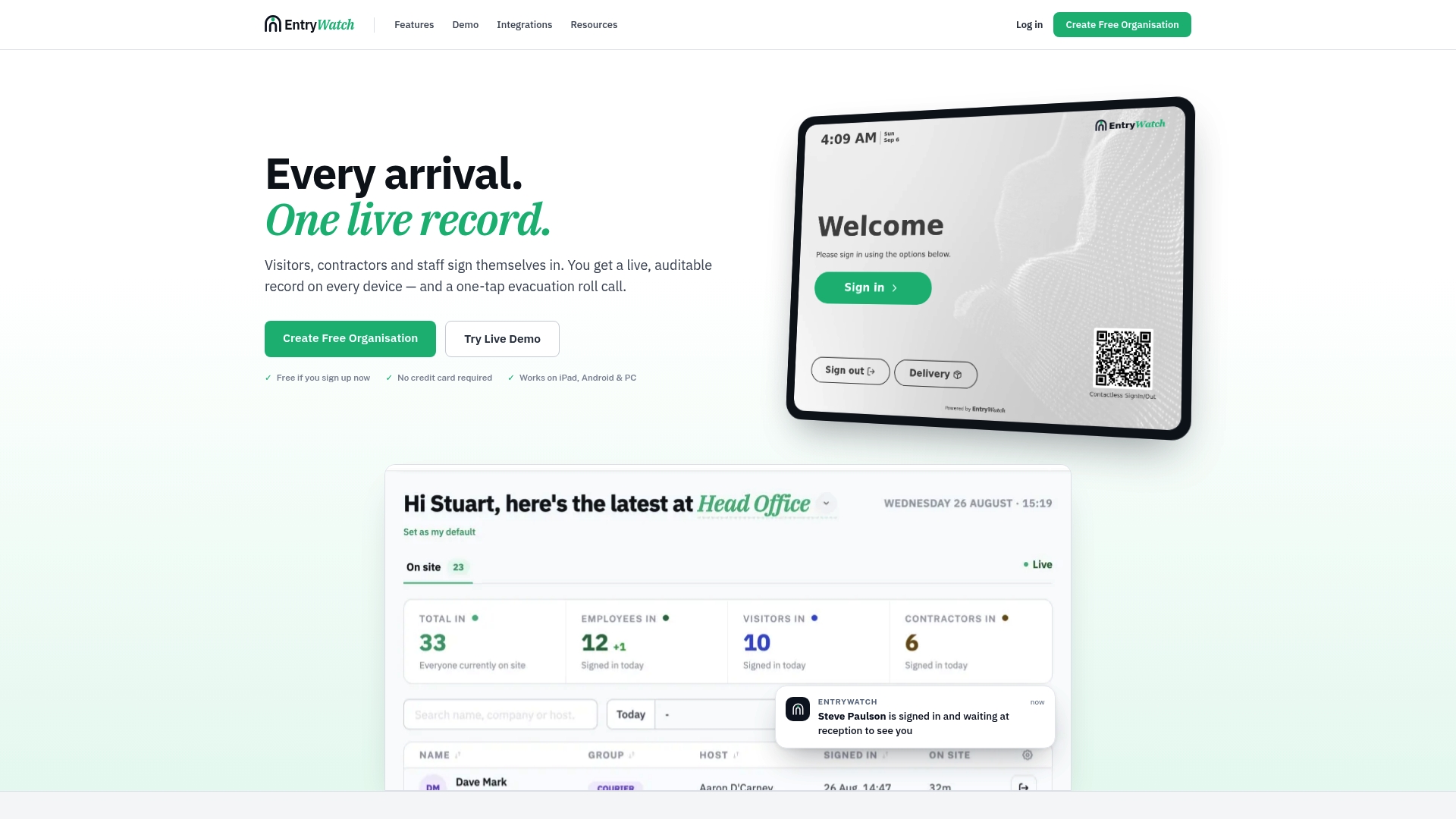
If you manage a shared building, start by reviewing our visitor management features, then check our Founding offer, which gives early adopters full access to the platform at no cost until 2027.
FAQ
What is multitenant software?
Multitenant software is a single platform that serves multiple separate organizations or tenants, with each tenant’s data and settings kept isolated from the others. In a visitor management context, this means each tenant in a shared building can configure its own visitor types, forms, and notifications without affecting other tenants on the same system.
What is a visitor management system and what are its benefits?
A visitor management system digitally records who enter a building, when, and whom they are visiting, replacing paper sign-in sheets with kiosks, pre-registration, or QR check-in. Its main benefits are faster check-in, an auditable visitor log for security and compliance, and faster accountability during emergencies through automated roll call.
What is the best app for managing gated communities?
There is no single standard answer for gated communities, since needs vary by site size, access points, and resident versus visitor traffic. Look for a system with tenant or household-level permissions, visitor pre-registration, and an auditable entry log rather than a specific named product.
How many types of visitors are there?
Visitor categories typically include general guests, contractors, deliveries, and scheduled appointments, though exact definitions vary by building and industry. A well-configured visitor management system lets each tenant define its own visitor types and apply different sign-in rules, forms, or access rules to each one.
Sources
- How to Plan for Workplace Emergencies and Evacuations
- Occupant Emergency Programs: An Interagency Security Committee Guide
- ICO: Storage limitation and data retention guidance
- ASIS access control research report