%20--%3e%3cdefs%3e%3cstyle%3e%20.st0%20{%20fill:%20none;%20stroke:%20%230f172a;%20stroke-linecap:%20round;%20stroke-width:%205.5px;%20}%20.st1%20{%20fill:%20%2310b981;%20}%20%3c/style%3e%3c/defs%3e%3cpath%20class='st0'%20d='M2.75,42.01v-20.12C2.75,11.32,11.32,2.75,21.89,2.75s19.14,8.57,19.14,19.14v20.12'/%3e%3cpath%20class='st0'%20d='M14.12,42.01v-13.62c0-4.29,3.48-7.78,7.78-7.78s7.78,3.48,7.78,7.78v13.62'/%3e%3ccircle%20class='st1'%20cx='21.89'%20cy='11.74'%20r='4.98'/%3e%3c/svg%3e)
Visitor Induction Video That Records Completion for Safety Managers

A visitor induction video must deliver a consistent, auditable briefing on site hazards, PPE requirements, and emergency arrangements before anyone enters an operational area. The video itself only does half the job: it needs to be paired with a digital sign-off or audit trail, because a briefing nobody can verify later does not meet accountability needs. Content has to stay site-specific and get refreshed as hazards change.
TL;DR:
- Visitor induction videos must be paired with a digital sign-off or audit trail to verify completion and ensure compliance.
- Content should be site-specific, regularly updated, and cover emergency procedures, hazards, PPE, traffic, escort policies, incident reporting, and site rules.
- Short, modular videos with comprehension checks and clear visuals are more effective than lengthy, continuous films for capturing attention.
- Delivery methods should tie video completion to sign-in systems, such as kiosks, QR codes, or LMS, with careful data retention for accountability.
- Focus on proportionate inductions tailored to visitor type, emphasizing record-keeping and verification over production quality.
Table of Contents
- What a visitor safety induction video is and why it matters for compliance
- Mandatory content checklist: exact topics your video should cover
- Design and content best practices for effective induction videos
- Delivery and accountability: tying video to sign-in and roll call
- Implementation checklist: plan, produce, test, deploy, and maintain
- Practitioner notes: combine video with a digital sign-in record
- Editorial perspective: proportionate inductions beat long generic videos
- Alternative delivery option: pairing video with EntryWatch
- FAQ
- Sources
What a visitor safety induction video is and why it matters for compliance
A visitor safety induction video is a recorded briefing that communicates the risks, rules, and emergency procedures a person needs to know before entering a workplace. It exists to meet a basic legal and operational requirement: anyone present on a site, even briefly, needs enough information to stay safe and respond correctly if something goes wrong. Site induction guidance from HSE states that inductions should be site specific and proportionate, which means a quick delivery visit does not need the same depth as a week-long contractor placement.
That proportionality shapes who gets what:
- Occasional visitors on a short, escorted visit can often be covered by a condensed briefing paired with continuous supervision.
- Unescorted contractors and suppliers working independently need a full recorded induction with verification of completion.
- Repeat contractors may need periodic refreshers rather than the full induction every visit.
- Site tours with multiple visitors benefit from a single video playback before entry, followed by individual sign-off.
Mandatory content checklist: exact topics your video should cover
A video that skips any of these leaves a gap a regulator or an incident investigation will find quickly. Treat this as the minimum scope for scripting or auditing an induction video.
- Emergency arrangements and muster points: what alarm sounds mean, where to go, and who to follow.
- Site-specific hazards: the risks unique to that site, how to recognize them, and how to avoid them.
- Minimum PPE requirements, introduced after behavioral guidance rather than before it. HSE guidance on managing risk using PPE treats PPE as a last-resort control, so the video should lead with hazard avoidance and only then specify what to wear.
- Traffic management and restricted areas: vehicle routes, pedestrian paths, and zones that require an escort.
- Escort policy: when a visitor must stay with a host and when they can move independently.
- Incident reporting and first-aid contact: who to tell, how, and where first-aid points are located.
- Expected behavior: smoking areas, mobile phone rules, photography restrictions, and similar site policies.
HSE’s induction presentation template recommends tailoring delivery and pacing to the site while keeping a record of attendees and content covered, which supports the case for pairing video with a logged sign-off rather than treating the recording as sufficient on its own.
Design and content best practices for effective induction videos
Length is the first decision point. Bite-sized modules outperform a single long film because viewers retain less once attention drifts past a few minutes. The Highways Common Induction splits its content into nine short modules with knowledge checks built in rather than one continuous briefing.
A few other choices matter as much as length:
- Animation versus live action: animation works well for hazards that are hard to film safely or hard to see, like underground services or chemical exposure; live footage grounds the briefing in the real site.
- Captioning and plain language: a multilingual or high-turnover workforce needs subtitles and short sentences, not technical jargon.
- Short comprehension checks: a brief quiz or acknowledgement step after viewing confirms the content landed, not just that the video played.
- Separate universal from site-specific content: keep core policy in one stable video and deliver daily hazard updates through a shorter, separate briefing so you are not re-editing the whole film every week.
Pro Tip: Script the emergency procedure section first. If viewers remember nothing else, that is the part that has to stick.
Delivery and accountability: tying video to sign-in and roll call
A video that plays is not the same as a video that is recorded as complete. The gap between those two things is where most compliance evidence falls apart after an incident.
Three delivery methods cover most sites:
- Kiosk playback at reception, where the visitor watches the induction as part of sign-in before a badge is issued.
- QR-to-video with digital acknowledgement, letting a visitor scan a code at the gate, watch on their own device, and confirm completion digitally.
- LMS or emailed links tied to sign-in, useful for contractors who need to complete induction before arrival.
Whichever method you choose, link completion to the visitor log, badge printing, or roll-call system that will matter in an emergency. University contractor induction pages commonly require watching the video, then completing an online questionnaire, before an ID card is issued, which creates exactly that kind of record.
Check local data-retention and privacy rules before storing viewing records or acknowledgement data, since requirements vary by jurisdiction and by what personal information the sign-off captures.
Implementation checklist: plan, produce, test, deploy, and maintain
Commissioning an induction video works best as a sequence rather than a single production sprint.
- Plan audience segmentation and risk profile: separate escorted visitors from unescorted contractors before scripting anything.
- Script core messages and visuals around the top hazards and a short set of site “golden rules” rather than trying to cover everything.
- Pilot test with real visitors, and record comprehension results from the knowledge check to see what actually lands.
- Deploy via kiosks, QR workflows, or an LMS, and link each completion to the sign-in system already in use on site.
- Set a review schedule: daily hazard updates delivered separately, and a periodic review of the core video, at least annually or whenever site layout or major hazards change.
Skipping the pilot step is the most common mistake. A script that reads clearly rarely plays the same way on a kiosk screen in a noisy reception area.
Practitioner notes: combine video with a digital sign-in record
Video is a delivery method, not a compliance framework on its own. Compliance depends on linking completion to something auditable: a QR check-in, a badge print, or a digital acknowledgement tied to the sign-in record.
Our system supports that pairing directly:
- Contactless sign-in and self-service kiosks that can play induction videos before badge issuance.
- Real-time visitor logs that can record who watched what and when.
- Emergency roll-call tools that use the same records as sign-in.
Pair a core induction video with a shorter daily hazard briefing rather than rebuilding the whole film for minor site changes.
Editorial perspective: proportionate inductions beat long generic videos

The instinct to build one polished, comprehensive induction film is understandable, but it usually produces a video people stop watching halfway through. A short, targeted module covering the real hazards on that site, backed by a solid sign-off, teaches more than a slick fifteen-minute production nobody finishes.
Production value matters less than most teams assume. What actually determines whether an induction works is whether completion gets recorded accurately and whether the emergency roll call is correct when it counts. Culture, supervision, and how seriously a site treats the sign-off step do more for safety than animation quality ever will.
— Flipmind
Alternative delivery option: pairing video with EntryWatch
A well-scripted induction video still needs a reliable way to prove who watched it and when. We built EntryWatch around that gap: contactless sign-in, self-service kiosks that play your induction content before badge issuance, and a real-time, auditable visitor log that feeds directly into emergency roll call.
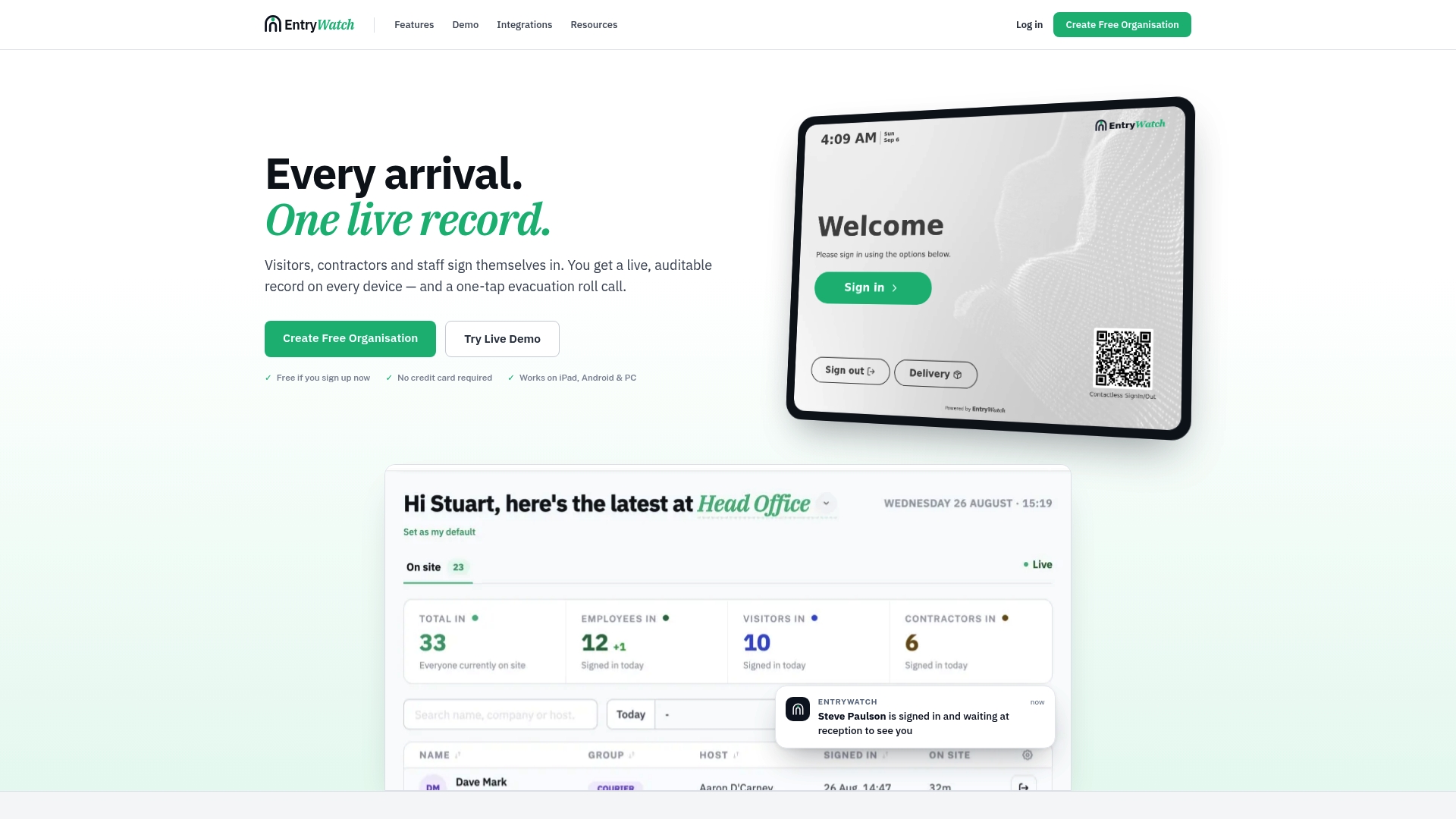
Instead of running video playback and visitor sign-in as two separate systems, you get one workflow where watching the briefing and signing in happen together, and the record stays available for audits or incident reviews. The approach suits construction and manufacturing sites, engineering firms, and other environments where contractor turnover is high.
Check our visitor management features or see current plans to find a setup that fits your site.

FAQ
What is a visitor safety induction?
A visitor safety induction is a briefing given before someone enters a workplace, covering the hazards, PPE requirements, and emergency procedures relevant to that site. HSE guidance recommends inductions be proportionate, so a short escorted visit needs less depth than an unescorted contractor placement.
What is a safety briefing for visitors?
A safety briefing for visitors is a condensed version of a full induction, typically used for escorted guests who will be supervised throughout their visit. It usually covers emergency muster points, key hazards to avoid, and basic site rules, delivered verbally, on video, or through signage at reception.
Can you provide an example of a safety induction training?
A common example is a contractor watching a short induction video at a kiosk, then completing an online questionnaire before an ID badge is issued, a pattern used at sites like Keele University. The Highways Common Induction offers another model, using modular video content with built-in knowledge checks.
What is the main reason for site inductions?
The main reason for site inductions is accountability: making sure everyone on site understands the hazards and emergency procedures, and that their understanding is documented. A video delivers the message, but pairing it with a digital sign-off or sign-in record is what makes that accountability auditable after the fact.
Sources
For readers who want to verify requirements or build from an existing template, a few primary sources cover most of what a safety team needs. HSE’s site induction guidance sets out proportionality principles, while its induction presentation template offers delivery and record-keeping hints. The Highways Common Induction appendix includes example topic lists for occasional visitors, and Keele University’s contractor induction page shows a working video-plus-questionnaire workflow. For teams exploring video-first onboarding more broadly, Kept’s engineering onboarding example is worth a look.