%20--%3e%3cdefs%3e%3cstyle%3e%20.st0%20{%20fill:%20none;%20stroke:%20%230f172a;%20stroke-linecap:%20round;%20stroke-width:%205.5px;%20}%20.st1%20{%20fill:%20%2310b981;%20}%20%3c/style%3e%3c/defs%3e%3cpath%20class='st0'%20d='M2.75,42.01v-20.12C2.75,11.32,11.32,2.75,21.89,2.75s19.14,8.57,19.14,19.14v20.12'/%3e%3cpath%20class='st0'%20d='M14.12,42.01v-13.62c0-4.29,3.48-7.78,7.78-7.78s7.78,3.48,7.78,7.78v13.62'/%3e%3ccircle%20class='st1'%20cx='21.89'%20cy='11.74'%20r='4.98'/%3e%3c/svg%3e)
Contractor Orientation Quiz for H&S Teams: 12 Kiosk Questions

A contractor orientation quiz is a short digital induction delivered through your sign-in workflow that confirms a contractor has read your site rules and creates an auditable record of what they understood. We built this approach for operations and health and safety teams who need fast verification at the door and a defensible paper trail afterward. A platform like EntryWatch lets you pilot one at a single site before rolling it out wider.
TL;DR:
- Reserve full quizzes for unescorted or high risk work; escorted, low risk visits can use a shorter acknowledgment instead to keep checks proportionate.
- A typical quiz has 8 to 12 questions and an approximately 80% pass threshold, covering site rules, emergencies, PPE, and trade specific hazards.
- Keep each result linked to the contractor’s identity, date, quiz version, answers, verification method, and follow up action to support audits and OSHA expectations.
- Pass triggers badge printing, while a failure should alert the host before access is granted; allow one retake, then require a host led briefing.
- Start with one trade or zone, track induction time, pass rate, and host escalations, then expand only when the pilot results support wider use.
Table of Contents
- Why a digital contractor orientation quiz adds value in contractor onboarding
- What to include in the quiz: required items and best-practice question types
- How to deliver the quiz inside your sign-in workflow
- Records, verification, and compliance: mapping your quiz to OSHA and HSE expectations
- Sample quiz structure and 12 example questions you can copy or adapt
- From the operations desk: quick lessons learned and pilot suggestions
- How EntryWatch helps run contractor orientation quizzes
- FAQ
- Sources
Why a digital contractor orientation quiz adds value in contractor onboarding
In-person inductions work, but they do not scale well when contractors arrive at different times, speak different first languages, or visit a site only once a month. A digital quiz at sign-in solves that by delivering the same core content every time, with no variation based on who happens to be at reception.
The practical gains show up fast:
- Every contractor answers the same questions, so understanding is checked consistently rather than assumed.
- Reception no longer becomes a bottleneck when ten contractors arrive at once for a shutdown or turnaround.
- A pass or fail result gives you a clear, documented basis for granting escorted or unescorted access.
- Multi-employer sites with rotating subcontractors get a repeatable record instead of a sign-in sheet with a signature nobody can read later.
This approach earns its place on sites with unescorted contractor access, hazardous zones, or several employers working side by side, where a generic sign-in sheet cannot show that anyone actually understood the risks.
Pro Tip: Reserve the full quiz for unescorted or high-risk work and use a shorter acknowledgement for low-risk, escorted visits so the process stays proportionate.
What to include in the quiz: required items and best-practice question types
A good orientation quiz is short, specific to the site, and tied to a real record. Build it around four mandatory content blocks and a handful of question formats that keep it quick without making it shallow.
- Site rules: parking, restricted zones, reporting procedures, and who to contact on arrival.
- Emergency procedures: alarm signals, nearest exits, and the assembly point for a roll call.
- PPE requirements: what is mandatory on site and where additional gear applies.
- Task-specific hazards: confined spaces, hot work, working at height, or whatever applies to that contractor’s trade.
- Acknowledgement statements for items that do not need a right or wrong answer, just confirmation of having read them.
- Multiple-choice questions for facts that matter, such as which exit to use from a specific work area.
- Conditional branching so an electrician sees different hazard questions than a roofer, instead of one generic quiz for everyone.
Keep the language plain and the reading level low, since not every contractor reads in their first language fluently. Offer translated versions or an assisted, host-guided option where a kiosk screen alone is not enough.
Every answer should be timestamped, tied to a pass threshold, and recorded against the contractor’s identity, not left as an anonymous completion. That link between a named person, a date, and a result is what turns a quiz into a usable record later.
Pro Tip: Write questions around what a contractor needs to do in an emergency, not trivia about policy numbers nobody will recall under pressure.
How to deliver the quiz inside your sign-in workflow
The quiz works best when it rides inside a sign-in step the contractor already expects, rather than as a separate form to chase down later. Three delivery patterns cover most sites.
- Pre-arrival: send a link by email or SMS before the visit so a first-time contractor completes it before setting foot on site.
- On-kiosk self-service: the contractor signs in at a mobile kiosk or QR code, answers on the spot, and proceeds once they pass.
- Host-invited: a host triggers the quiz when inviting a contractor for a scheduled visit, so it is waiting when they arrive.
On the kiosk screen itself, keep each question on its own short screen with a visible progress indicator so contractors do not feel stuck partway through. Branching logic should route a plumber away from scaffold questions and a scaffolder away from confined-space ones. Set a clear retry policy, typically one or two attempts before a host is alerted.
Tie the result directly to what happens next: print a badge only after a pass, and send an automatic alert to the host if a contractor fails so someone can intervene before access is granted. Attach the quiz result to that contractor’s profile so it travels with their record across future visits.
A few operational controls keep this from drifting out of date: version every quiz so you know which edition a contractor took, track document expiry for certifications tied to the induction, and define what happens procedurally when someone fails, whether that means a supervised walkthrough or a rescheduled visit.

Pro Tip: Combine the quiz with a QR-based check-in step for contractors who arrive without a pre-booked host, so the two-minute process starts the moment they scan in.
Records, verification, and compliance: mapping your quiz to OSHA and HSE expectations
Regulators care less about the format of your induction and more about whether you can prove understanding happened and keep a record of it. OSHA’s standard interpretation on the Process Safety Management standard confirms that a host employer’s training can satisfy contractor training requirements, provided the host uses an adequate method to verify the contractor actually understood the material, and the contract employer keeps records that include the contractor’s identity, the date, and the verification method used.
In the UK, HSE guidance on site rules and induction takes a similar position from a different angle: inductions must be site-specific and proportionate to the risk, and any contractor working unescorted needs a full induction covering the particular risks and controls on that project, not a generic safety briefing reused across sites.
What this means in practice for your records:
- Store the quiz version a contractor completed, not just a generic “induction complete” flag.
- Keep the actual answers given, the timestamp, and the contractor’s identity together as one record.
- Log the pass or fail outcome and any follow-up action taken, such as a supervised re-briefing.
- Make the whole set exportable so an auditor or inspector can review it without you reconstructing it from memory.
A quiz-linked sign-in system can produce an exportable, timestamped log tying each contractor’s identity, induction date, and verification method into one auditable record, which is the same combination OSHA’s interpretation points to as adequate verification.
Sample quiz structure and 12 example questions you can copy or adapt
Below is a starting set grouped by topic that you can adapt to your own site rules and hazards.
- “What is the site assembly point in case of an evacuation alarm?”
- “Which exit route is closest to the loading bay?”
- “True or false: you may prop open a fire door for ventilation.”
- “Which PPE is mandatory in the warehouse zone?”
- “What should you do if your PPE is damaged during your shift?”
- “Who do you report to if you notice a hazard on site?”
- “Is hot work permitted without a permit? Yes or no.”
- “What is the minimum clearance required around overhead power lines on this site?”
- “I confirm I have read and understood the site rules provided.”
- “I confirm I have no known medical condition that affects my ability to work safely today.”
- “What number do you call in a medical emergency on this site?”
- “Where is the first aid station located in your work area?”
Allow one retake before escalating to a host-led briefing, and tag each quiz with a version ID linked to the specific site or zone so you can tell at a glance which rules a contractor was tested on.
From the operations desk: quick lessons learned and pilot suggestions
Start with one trade or one zone rather than rolling a quiz out site-wide on day one. Keep the question count tight and specific to that area’s real hazards, since a bloated generic quiz gets rushed through rather than read. Track induction time, pass rate, and how often a host gets escalated, then expand once those numbers look right.
— Flipmind
How EntryWatch helps run contractor orientation quizzes
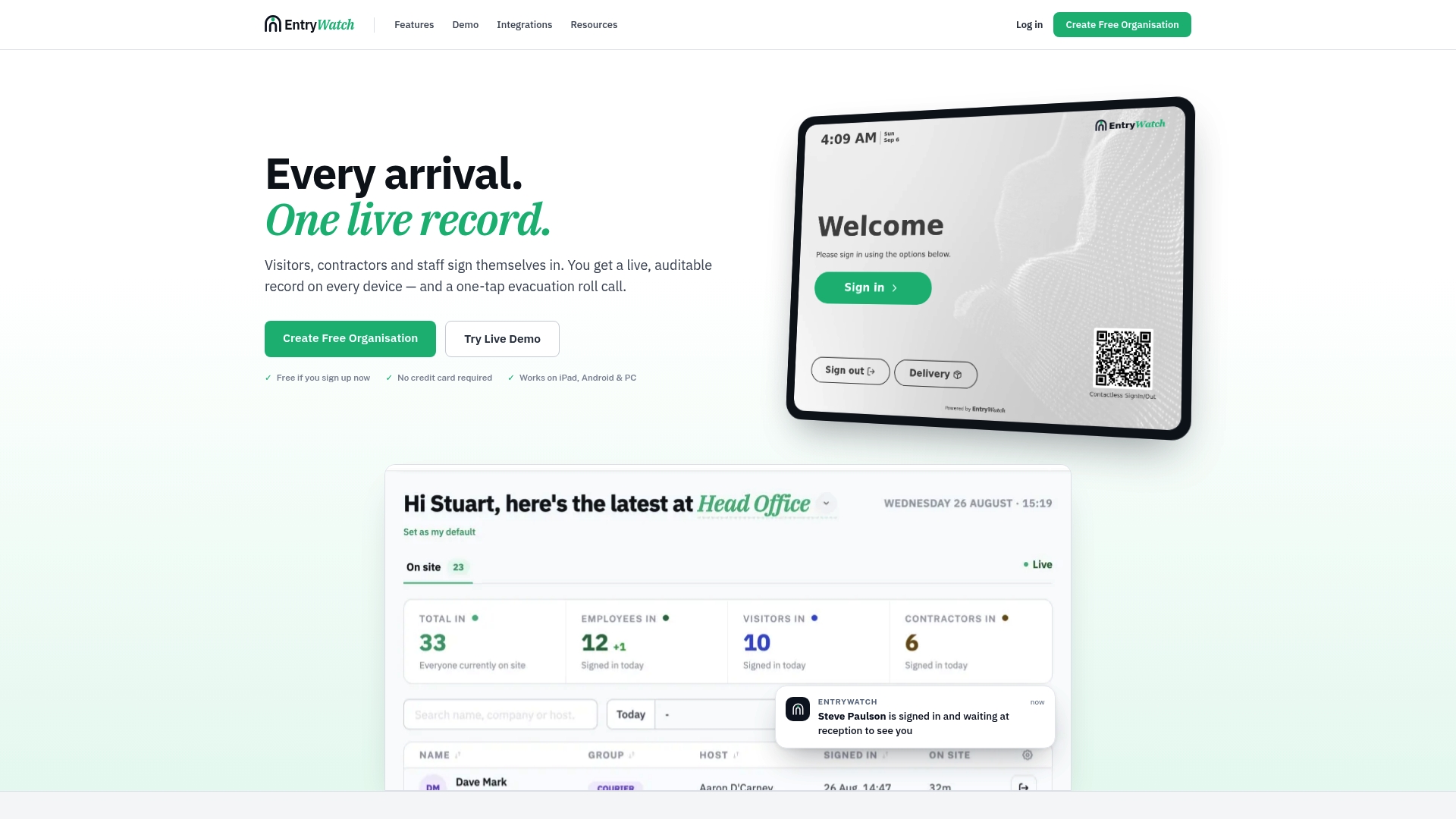
We built EntryWatch around the exact workflow this article describes: a self-service kiosk that delivers the quiz, captures a timestamped result, and only prints a badge once a contractor passes.
- Self-service kiosks and contractor sign-in handle the quiz without adding staff at reception.
- Digital forms cover site rules, health declarations, and NDAs alongside the quiz itself.
- Auditable visitor history keeps every answer, timestamp, and identity together for later review.
- Automatic evacuation roll calls use the same sign-in data to show who is on site right now.
- Badge printing on the hardware we support ties physical access to a passed quiz.
Our Founding plan gives early adopters full platform access free until 2027. Visit our pricing page to start a pilot on your next contractor visit.
FAQ
What is a contractor orientation quiz?
A contractor orientation quiz is a short set of digital questions delivered during sign-in that checks whether a contractor has read and understood site rules, emergency procedures, and task-specific hazards before they gain access. It typically runs on a kiosk, QR code, or pre-arrival link and produces a timestamped record tied to that contractor’s identity.
How many questions should a contractor orientation quiz have?
A workable quiz runs eight to twelve questions covering emergency procedures, PPE, site rules, and task hazards, with a pass threshold often set around 80%. Keeping it short and site-specific, as HSE’s induction guidance recommends, keeps completion rates high.
Does a digital quiz meet OSHA training verification requirements?
OSHA’s interpretation allows a host employer’s training to satisfy contractor training obligations when the host verifies understanding and keeps records including identity, date, and verification method. A quiz that captures those three elements fits that expectation directly.
Who is responsible for keeping contractor training records on a multi-employer site?
OSHA guidance on communication and coordination recommends host employers and contractors agree in advance, ideally in contract documents, on which party provides training and which party keeps the records. Settling this before work starts avoids gaps when an inspector asks for proof later.
Can a contractor orientation quiz replace an in-person induction?
A quiz works well for returning contractors or lower-risk visits, but unescorted contractors entering hazardous areas still need a full, site-specific induction under HSE guidance. A hybrid approach, where the quiz confirms recall of material already covered in person, fits most sites better than relying on the quiz alone.
Sources
- Employer Responsibilities and Contractor Responsibilities under the PSM Standard | Occupational Safety and Health Administration
- Site rules and induction - HSE